

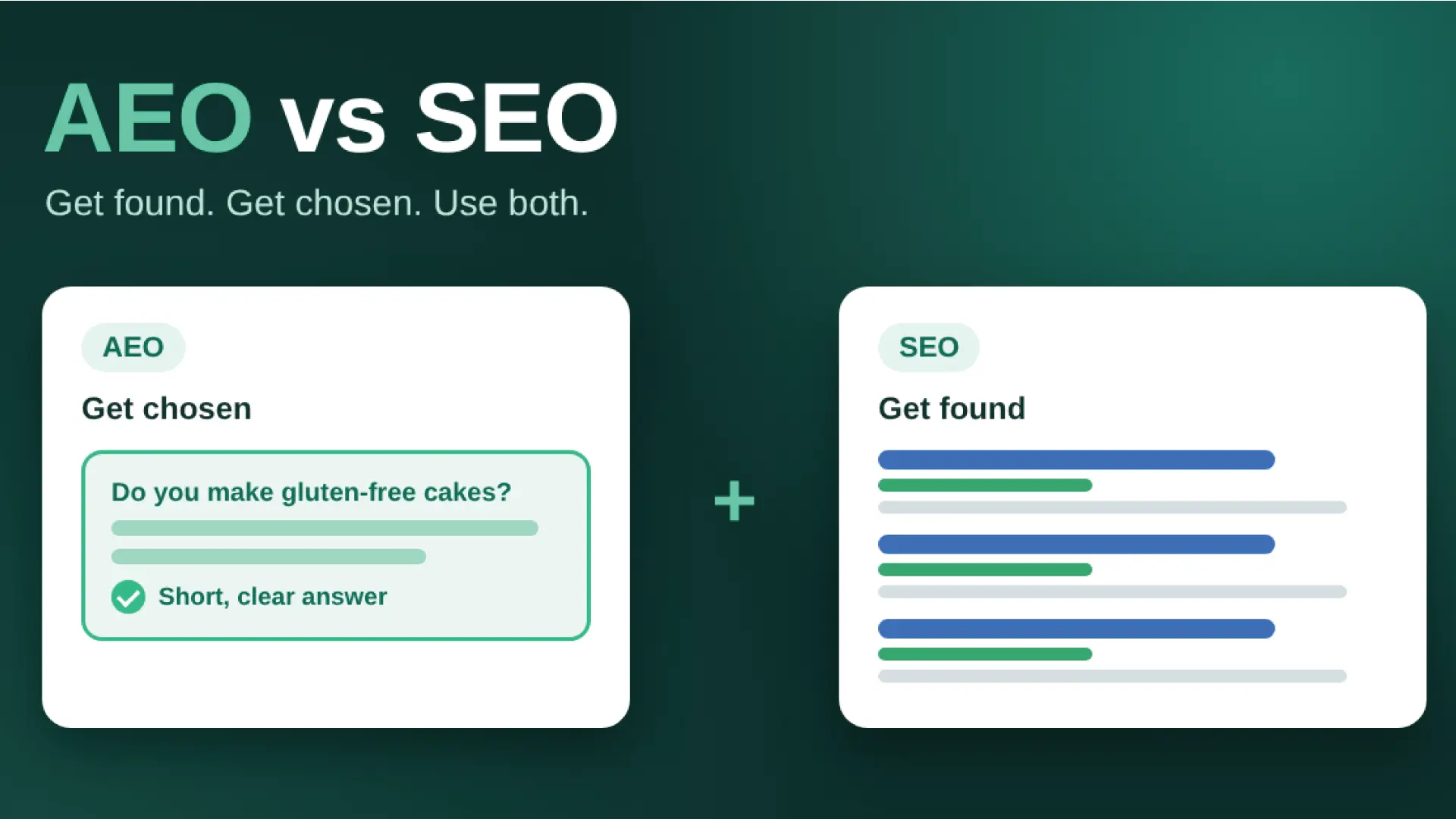

What is AEO vs SEO? AEO and SEO are the two optimization methods that help online content or businesses rank in the search results of different search engines. The main difference is where each one makes your content appear. SEO brings content in search engines like Google or Bing while AEO (answer engine optimization) helps your content become the answer in AI tools and answer boxes. In short, SEO makes your content and business visible to the audience, and AEO lets your audience choose your content in the form of best suitable answer. From now on, most small businesses should use both because these two work together.
| Term | Stands for | What it does |
| SEO | Search engine optimization | It improves visibility and ranking in search engines. |
| AEO | Answer engine optimization | It helps your content become the best answer for your audience. |
The purpose of this guide is to explain how small businesses can use answer engine optimization and search engine optimization for their online content. In this guide, you will learn:
- How AEO and SEO differ, and where they overlap.
- Whether AEO replaces traditional SEO.
- Four simple steps to add AEO to your current work.
Furthermore, our detailed guide for the future of SEO can help you learn how to optimize your content.
What Is AEO vs SEO in Simple Terms?
In simple terms, AEO and SEO are two gateways to your business or online content. It is SEO that helps your business appear in the search results. Moreover, SEO helps you improve content quality, maintain site health, build links, and manage local listings. On the other hand, AEO (answer engine optimization) makes it possible for your content to appear in searches on AI tools. This appearance is always in the form of an answer. Answer results can bring your content into an AI overview, which helps users choose the best option.
For Example
Take an example of a local bakery in your suburbs. A customer asks, “Do you make gluten-free birthday cakes?” SEO helps the bakery appear in the results for that query, while AEO helps the page reply in one clear sentence.
Here both serve the same customer. The only difference is that SEO brings them to your page, and AEO makes sure they get a quick, plain answer when they arrive. Remember, don’t create content that pits the two against each other. Treat them as necessary components of optimization, because AEO builds on SEO instead of competing with it.
AEO vs SEO: Key Differences
The real difference between SEO and AEO (answer engine optimization) comes down to their strategies. SEO involves several phases to get content optimized, and it needs some technical expertise. In contrast, AEO needs a few extra techniques on top of the technical work to present your content as an answer, which people see in the answer box. This table shows the main differences.
| Aspect | SEO | AEO |
| Main goal | To improve rankings to earn clicks | Enable the content to be chosen and cited as the answer |
| Where it shows up | SERP results & maps | AI answers, answer boxes, assistants |
| Content style | Full pages built around topics | Short direct answers inside clear pages |
| Success signals | Rankings, traffic, leads | Mentions, citations, calls, leads |
| Typical tactics | Keywords, links, site speed, local listings | Question headings, direct answers, clear facts, consistent business details |
Despite the big difference, the two still overlap in one sense: both rely on helpful content, accurate facts, and a site that search engines can read. Here’s how that looks in practice:
A plumber might write a full guide on drain care. Initially, that is the SEO work: making the guide useful for readers. If it is helpful, Google may rank it higher and recommend it in searches. To add AEO, he would put a two-sentence reply to “How often should drains be cleaned?” near the top. The guide stays the same, but the short reply is easier to quote.
Success also looks different with AEO and SEO, for SEO success often shows up as visits while AEO success might show up as a phone call after someone sees your name in an answer. So track both clicks and calls. You may also hear about featured snippets. A snippet is one Google result format, while AEO is broader.
Does AEO Replace Traditional SEO or Complement It?
AEO can never replace the traditional methods of SEO; it complements SEO. No AI system can generate an answer on its own, because it still depends on web pages. Google says a page must be indexed and eligible for a snippet to appear in its AI features. Its AI features guidance also says no special optimizations are necessary.
So discoverable, trustworthy content and sound technical foundations still matter. Think of SEO as the foundation and AEO as a layer on top. If your pages are slow, outdated, or hard to read, short answers won’t fix that. Search habits are mixed, too. Some people still click links, while others read the answer first. In 2026, it makes sense to use both in your content. To see the wider picture, read how AI search is changing results. Remember, no one can guarantee inclusion or citations in AI-generated answers.
How to Integrate AEO With Traditional SEO Strategies
To integrate AEO with traditional SEO strategies, you don’t need a new website or a separate budget. It is an easy task for you to fold AEO into the work you already do. It makes AEO optimization for a small business realistic. Even one improved page is a useful start.
- Start with existing pages. At first, find the pages that are already getting impressions and rankings. Analyze the whole page for errors and issues. Then, fix any technical SEO problem on them. There can be slow loading or blocked pages.
- Answer customer questions. Your headings should be questions that users usually ask, then put a concise answer under each. For example, change “Our drain services” to “How do I clear a blocked drain?” Solid on-page SEO habits, like clear titles and headings, make this easier.
- Strengthen trust. Use accurate author names, business details, and locations. Cite reliable sources, such as government sites and trade bodies. Keep your business profiles consistent across the web. Accuracy matters, because customers and AI tools both rely on it.
- Review AI-generated answers. Ask a few assistants your customers’ top questions and note any wrong or missing details. Then fix those facts on your website, and add a clear answer where a page is missing.
Repeat these steps every quarter. Small, steady updates beat one big rewrite. To track progress, see how to measure visibility when clicks fall in our pillar guide.
A Simple Decision Rule
Simply start with the most useful existing pages, and add AEO to SEO. Small, steady changes will serve you better than a big project. So, pick one page this week and add a short, clear answer under its main question. Note the date, then check impressions and calls in a month. That gives you real evidence of what works for your business. There’s no need to rush. If you’d like a second opinion, book a free SEO consultation. You can also see our approach to search visibility.
Frequently Asked Questions
A featured snippet is one specific Google search result format. AEO is broader. It aims to make your content useful as an answer across search features and AI assistants. A snippet might show one paragraph from your page, while an AI assistant may summarize several sources. So writing for snippets is one part of AEO.
Not quite, but they’re closely related. Generative engine optimization focuses on visibility in AI-generated answers. It also builds on many established SEO principles.
Yes. Many activities support both, such as clear headings, accurate facts, and fast pages. A coordinated content plan works better than two separate efforts, and one clear page can serve both.
Most small businesses benefit from a basic version. People ask questions before they buy, and clear answers help them decide. Start with your most useful pages instead of launching a big project.
Not for Google. Google says its AI features need no special files, markup, or schema. Its guide to generative AI search treats this work as SEO. Focus on clear content and indexed pages.
